A JOURNEY BENEATH THE FAMILIAR
There’s a whole
world below.
Leave the surface behind. Follow the light into the dark.
Discover what lives beyond the world we see.

01 SUNLIGHT ZONE
The world
we know.
Most of the ocean’s familiar colors live in a remarkably thin layer. Here, sunlight gives photosynthetic life the energy to begin a food web. Beneath this bright surface, another world is waiting.

Open field note
Sunlight generally supports photosynthesis in the upper 200 meters. The boundary shifts with water clarity and conditions.
02 TWILIGHT ZONE
The light
lets go.
Blue fades into indigo. A little sunlight still filters down, but not enough to power photosynthesis. In this dim water, some animals create light of their own.

Open field note
Bioluminescence is light produced through chemical reactions in living organisms. It is common among many ocean animals.
03 MIDNIGHT ZONE
A world with
its own stars.
At this depth, sunlight is gone. A flash, a lure, a moving point of light: in the open ocean’s darkness, light can help an animal communicate, hunt, or disappear.

Open field note
Some deep-sea anglerfishes carry a luminous lure. Different animals use bioluminescence in different ways; not every deep-sea animal glows.
04 ABYSSAL ZONE
Darkness.
Still, life.
The darkness continues, but the story does not end. The ocean’s deep habitats are home to organisms adapted to conditions very different from our own. Life has more than one way to make a living.
Open field note
At some deep-sea hydrothermal vents, microbes use chemical energy instead of sunlight, supporting communities around them. Vents occur at a range of depths.
05 HADAL ZONE
Deeper than
imagination.
Beyond 6,000 meters, the hadal zone follows the ocean’s trenches. This is no empty ending. Even here, scientists have found life. Our journey becomes quieter. Our questions get bigger.

Open field note
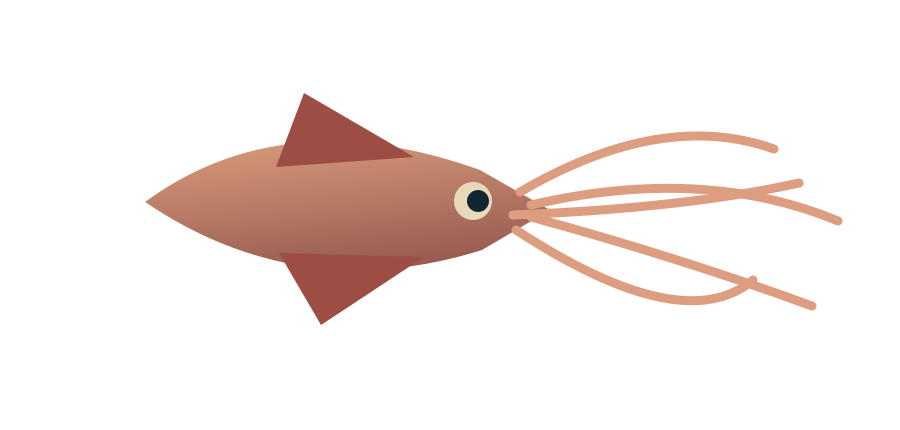
Ocean zones are broad scientific divisions, not hard walls. These illustrations suggest deep-ocean life; their placement is not a species depth record.
A LITTLE FURTHER INTO THE UNKNOWN
The ocean ends.
Your curiosity doesn’t.
Take a little of the deep with you. Save a personal expedition card with the zones you’ve visited and your deepest point.
- 01SUNLIGHT ZONENot explored
- 02TWILIGHT ZONENot explored
- 03MIDNIGHT ZONENot explored
- 04ABYSSAL ZONENot explored
- 05HADAL ZONENot explored
An illustrated SVG keepsake. No email needed.
↑ Return to the surface